Monday, November 30, 2009

St. Teresia Benedicta of the Cross

Born
  • Edith Stein
  • October 12, 1891
  • Breslau, German Empire
Died
  • August 9, 1942
  • Aged 50
  • Auschwitz Concentration Camp
  • Nazi-occupied Poland
Beatified
  • May 1, 1987
  • Cologne, Germany
  • Pope John Paul II
Canonized
  • October 11, 1998
  • Pope John Paul II
Feast     August 9

Source


St. Therese of the Child Jesus / Therese of Lisieux


  • Virgin and Doctor
  • Feast
  • Carmelite Proper
Born
  • Marie-Francoise-Therese Martin
  • January 2, 1873
  • Alencon, France
Died
  • September 30, 1897
  • Aged 24
  • Lisieux, France
Beatified
  • April 29, 1923
  • Pope Pius XI
Canonized
  • May 17, 1925
  • Pope Pius XI
Feast:     October 1

Major Shrine
  • Basilica of St. Therese in Lisieux

Sources:

OCDS Calendar for the Liturgy of the Hours, 2009

Sunday, November 29, 2009

The Sayings of Light and Love (159)


"The further you withdraw from earthly things the closer you approach heavenly things and the more you find God."

St. John of the Cross


Source:

St. John of the Cross, Collected Works
Revised Edition
Translated by:
Kieran Kavanaugh, OCD
Otilio Rodriguez, OCD


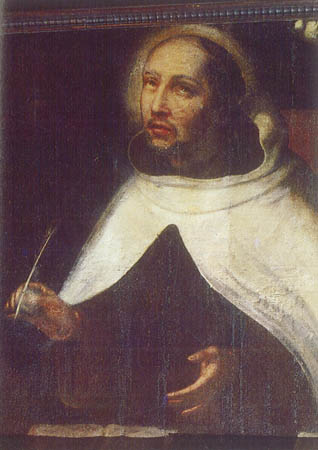
Image of St. John of the Cross

Wikipedia.com - St. John of the Cross
under Creative Commons Attribution/Share-Alike License 3.0 (Unported). and the GNU Free Documentation License


On the Importance of Spiritual Life (1)

"Genuine prayer must be reinforced with the fasts,
disciplines and periods of silence which the Order demands.
Prayer cannot be accompanied by self-indulgences."


St. Teresa of Avila

Picture of St. Teresa of Avila

Sayings on Poverty (2)

"Remember the blessings to be found in holy poverty;
it contains within itself all the good things of the world.
The chief honor of a poor man is in being really poor."

- St. Teresa of Jesus
 

The Way of perfection

Picture of St. Teresa of Avila

Tuesday, November 24, 2009

OCDS-Subic Community Council 2009-2012

My Congratulations to Our new sets of Community Councilors and to our Community Council president.

  • Council President :    Sis. Amparo (Ampy) Zerudo, OCDS 
  • First Councilor     :     Sis. Luvimin Afable, OCDS
  • Second Councilor :     Sis. Elsa Pineda, OCDS
  • Third Councilor    :     Sis. Viring Delgado, OCDS

Please visit my other blog Carmelite Spirituality for complete story.

Powered by ScribeFire.

St. Teresa of Avila (Teresa of Jesus)

Liturgy of the Hours
  • St. Teresa of Jesus
  • Virgin Doctor
  • Solemnity
  • Carmelite Proper
Born:     
  • Teresa Sanchez de Cepeda y Ahumada
  • March 28, 1515
  • Gotarrendura (Avila)
  • Old Castile
  • Kingdom of Spain
Died:    
  • October 14, 1582
  • (Aged 67)
  • Alba de Tormes, Salamanca
  • Kingdom of Spain
Beatified:    
  • April 14, 1614
  • Rome
  • Pope Paul V
Canonized: 
  • March 12, 1622
  • Rome
  • Pope Gregory XV
Feast:          October 15

Major Shrine:    

  • Convent of the Annunciation
  • Alba de Tormes, Spain

Sources:


OCDS Calendar for the Liturgy of the Hours, 2009

Wikipedia.com - St. Teresa of Jesus

Sunday, November 22, 2009

St. John of the Cross

Liturgy of the Hours
  • Priest and Doctor
  • Solemnity
  • Carmelite Proper
Born:    
  • Juan de Yepes Alvarez
  • 24 June 1542
  • Fontiveros, Spain
Died:  
  • December 14, 1591
  • Aged 49
  • Ubeda, Andalusia, Spain
Beatification
  • 25 January 1675
  • Pope Clement X
Canonization
  • 27 December 1726
  • Pope Benedict XIII
Feast Day:    14 December
                    24 November(General Roman Calendar, 1738-1969)

Major shrine  
  • Tomb of Saint John of the Cross
  • Segovia, Spain

John of the Cross (San Juan de la Cruz) (24 June 1542 – 14 December 1591), born Juan de Yepes Alvarez, was a major figure of the Counter-Reformation, a Spanish mystic, Catholic saint, Carmelite friar and priest, born at Fontiveros, Old Castile.

Saint John of the Cross was a reformer of the Carmelite Order and is considered, along with Saint Teresa of Ávila, as a founder of the Discalced Carmelites. He is also known for his writings. Both his poetry and his studies on the growth of the soul are considered the summit of mystical Spanish literature and one of the peaks of all Spanish literature. He was canonized as a saint in 1726 by Pope Benedict XIII. He is one of the thirty-three Doctors of the Church. When his feast day was inserted into the General Roman Calendar in 1738, it was assigned at first to 24 November, since his date of death was impeded by the then existing octave of the Feast of the Immaculate Conception. This obstacle was removed in 1955 and in 1969 his feast day was moved to his date of death, 14 December.

Early life and education

St. John was born by the name of Juan de Yepes Alvarez into a Jewish converso family in a small community near Ávila. His father died when he was young, and so John, his two older brothers and his widowed mother struggled with poverty, moving around and living in various Castilian villages, with the last being Medina del Campo, to which he moved in 1551. There he worked at a hospital and studied the humanities at a Society of Jesus (Jesuit) school from 1559 to 1563. The Society of Jesus was a new organization at the time, having been founded a few years earlier by the Spanish St. Ignatius Loyola. On 24 February 1563 he entered the Carmelite order, adopting the name Fr. Juan de Santo Matía.

The following year (1564) he professed as a Carmelite (was promoted from novice status) and moved to Salamanca, where he studied theology and philosophy at the University and at the Colegio de San Andrés. This stay would influence all his later writings, as Fray Luis de León taught biblical studies (Exegesis, Hebrew and Aramaic) at the University. León was one of the foremost experts in Biblical Studies then and had written an important and controversial translation of the Song of Songs into Spanish. (Translation of the Bible into the vernacular was not allowed then in Spain.)

Priesthood and association with Saint Teresa of Avila


Saint John was ordained a priest in 1567, and then indicated his intent to join the strict Carthusian order, which appealed to him because of its encouragement of solitary and silent contemplation. Before this, however, he traveled to Medina del Campo, where he met the charismatic Saint Teresa de Jesús. She immediately talked to him about her reformation projects for the Carmelite order, and asked him to delay his entry into the Carthusians. The following year, on 28 November, he started this reformation at Duruelo together with Fr. Antonio de Jesús de Heredia, and the originally small and impoverished town of Duruelo became a center of religion.

John, still in his 20s, continued to work as a helper of Saint Teresa until 1577, founding monasteries around Spain and taking active part in their government. These foundations and the reformation process were resisted by a great number of Carmelite friars, some of whom felt that Teresa's version of the order was too strict. Some of these opponents would even try to bar Teresa from entering their convents.

The followers of St. John and St. Teresa differentiated themselves from the non-reformed communities by calling themselves the "discalced", i.e., barefoot, and the others the "calced" Carmelites.

Imprisonment, writings, torture, death and recognition
On the night of 2 December 1577, John was taken prisoner by his superiors in the calced Carmelites, who had launched a counter-program against John and Teresa's reforms. John had refused an order to return to his original house, on the basis that his reform work had been approved by the Spanish Nuncio, a higher authority than John's direct superiors in the calced Carmelites.  John was jailed in Toledo, where he was kept under a brutal regimen that included public lashing before the community at least weekly, and severe isolation in a tiny stifling cell barely large enough for his body. He managed to escape nine months later, on 15 August 1578, through a small window in a room adjoining his cell. (He had managed to pry the cell door off its hinges earlier that day). In the meantime, he had composed a great part of his most famous poem Spiritual Canticle during this imprisonment; his harsh sufferings and spiritual endeavors are then reflected in all of his subsequent writings. The paper was passed to him by one of the friars guarding his cell.

After returning to a normal life, he went on with the reformation and the founding of monasteries for the new Discalced Carmelite order, which he had helped found along with his fellow St. Teresa de Ávila.

He died on 14 December 1591, of erysipelas. His writings were first published in 1618, and he was canonized by Benedict XIII in 1726. In 1926, he was declared a Doctor of the Church by Pope Pius XI. When inserted into the Roman Catholic calendar of saints in 1738, his feast day was assigned to 24 November.  Pope Paul VI moved it to the dies natalis (birthday to heaven) of the saint, 14 December.

The Church of England commemorates him as a "Teacher of the Faith" on the same date.

Literary works


St. John of the Cross is considered one of the foremost poets in the Spanish language. Although his complete poems add up to fewer than 2500 verses, two of them—the Spiritual Canticle and Dark Night of the Soul are widely considered to be among the best poems ever written in Spanish, both for their formal stylistic point of view and their rich symbolism and imagery.

The Spiritual Canticle is an eclogue in which the bride (representing the soul) searches for the bridegroom (representing Jesus Christ), and is anxious at having lost him; both are filled with joy upon reuniting. It can be seen as a free-form Spanish version of the Song of Songs at a time when translations of the Bible into the vernacular were forbidden.

Dark Night of the Soul (from which the spiritual term takes its name) narrates the journey of the soul from her bodily home to her union with God. It happens during the night, which represents the hardships and difficulties she meets in detachment from the world and reaching the light of the union with the Creator. There are several steps in this night, which are related in successive stanzas. The main idea of the poem can be seen as the painful experience that people endure as they seek to grow in spiritual maturity and union with God. A year after writing this poem, in 1586 he wrote a commentary on Dark Night of the Soul with the same title. This commentary explains the meaning of the poem verse by verse.

St. John also wrote four treatises on mystical theology, two treatises concerning the two poems above, which set out to explain the true meaning of the poems verse by verse and even word by word.

The third work, Ascent of Mount Carmel is a more systematic study of the ascetical endeavour of a soul looking for perfect union, God, and the mystical events happening along the way. A four stanza work, Living Flame of Love describes a greater intimacy, as the soul responds to God's love. These, together with his Dichos de Luz y Amor, or "Sayings of Light and Love," and St. Teresa's writings, are the most important mystical works in Spanish, and have deeply influenced later spiritual writers all around the world. Among these can be named T. S. Eliot, Thérèse de Lisieux, Edith Stein (Teresa Benedicta of the Cross), and Thomas Merton. John has also influenced philosophers (Jacques Maritain), theologians (Hans Urs von Balthasar), pacifists (Dorothy Day, Daniel Berrigan, and Philip Berrigan) and artists (Salvador Dalí). Pope John Paul II wrote his theological dissertation on the mystical theology of Saint John of the Cross. Saint John is also mentioned in Allen Ginsberg's groundbreaking poem Howl,[and is quoted by Jonas Mekas in his epic film-diary work 'Walden'.


Notes:

*Added the Discaced Carmelites Liturgy of the Hours
** Citations were removed but can be found on the Original site

Resources:

OCDS Calendar for the Liturgy of the Hours, 2009  

John of the Cross. (2011, July 30). In Wikipedia, The Free Encyclopedia. Retrieved 16:31, August 2, 2011, from http://en.wikipedia.org/w/index.php?title=John_of_the_Cross&oldid=442135578 


Text: under http://creativecommons.org/licenses/by-sa/3.0/
 

Saturday, November 21, 2009

Sayings on Poverty (1)

"If the rule of poverty is truly kept, both chastity and all the other virtues are fortified much better."


St. Teresa of Avila

Picture of St. Teresa of Avila

Friday, November 20, 2009

A Simple Dedication for Someone Special...

You're my piece of mind, in this crazy world
You're every thing I've tried to find
Your love is a pearl
You're my Mona Lisa
You're my rainbow skies
And my only prayer is that you realize
You'll always be beautiful in my eyes...

The world will turn
And the seasons will change
And all the lessons we will learn
Will be beautiful and strange
We'll have our fell of tears
Our share of sight
My only prayer is that you realize
You'll always be beautiful in my eyes...

You will always be beautiful in my eyes
And the passing is the show
That you will always grow
Ever more beautiful in my eyes

And there are lines upon my face
From a life time of smiles
When the time comes to embrace
For one long last wine
We can laugh about how time really flies
We won't say goodbye
'Cause true love never dies
You'll always be beautiful in my eyes...

You will always be beautiful in my eyes
And the passing is the show
That you will always grow
Ever more beautiful in my eyes

The passing is the show
That you will always grow
Ever more beautiful in my eyes...


For you who has been, is, and will always be special to me. You know who you are, thanks for everything.


Powered by ScribeFire.

Wednesday, November 18, 2009

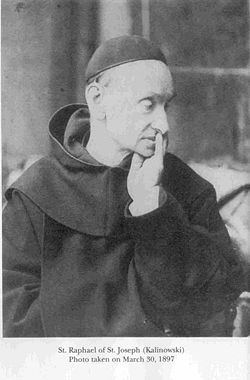
Saint Raphael Kalinowski of St. Joseph


Liturgy of the Hours

  • Priest
  • Memorial
  • Carmelite Proper

Born:

  • September 1, 1835
  • Place:  Vilnius, Lithuania

Died:   

  • November 15, 1907
  • 72
  • Wadowice, Poland

Beatification:

  • 1983
  • Krakow, Poland
  • Pope John Paul II

Canonization:

  • November 17, 1991
  • St. Peter's Basilica
  • Pope John Paul II

Feast Day: November 19

Resources:

Wednesday, November 11, 2009

A dedication...

After chatting with my sister, she made a request that I make a blog dedicated to those people who have been very special to me, or in one-way or the other have become a part of my life in the past 39 years of my existence.

And so after her very long deliberation and voice of convincing...here it goes...

....I wish to dedicate this blog to them.


***********************************************
Life at times can be interpreted as cruel
For one must give way so that others can move forward.
When someone laugh, others cry.
When someone wins, the other losses.


Yes it is indeed difficult to part ways
But at times, it's better to separate and simply let go
For the greater good of all.
-------------------------------------------------------------

When you came into my life, both of us were surprise
We both didn't expect things to happen so fast
We never knew why


But I guess it's much better for us to part ways
With words left unsaid, knowing fully
that the best expression of love is simply
by learning to let go.
------------------------------------------------------------

From the very beginning our destiny was written
Though we never really knew
We were meant for each other


What ever it was that took place in the past
what ever it has been, be rest assured that ....I will always be here.


To all of you, thank you for sharing a part of your life with me
And by allowing me to grow with you which made me become who I am today.


Tuesday, November 10, 2009

Pagkakaibigan

Here's another song that simply made me cry one day when I was attending Mass at our Parish. From the Gospel of St. John 15.7-13

It simply hit me so much that I eventually cried during communion. Unselfishness, commitment, care... to love someone simply means being able to give oneself.


Dedicated to everyone who has learned to give love without necessary expecting anything in return, for people who have simply learned to give themselves in the service of others.

For those who have simply learned to give their own lives, so that others may live.


To Jesus through Mary!

- Jov of the Sacred Heart of Jesus, OCDS

You can download a copy of this music from youtube by CLICKING THIS LINK.

Monday, November 9, 2009

The Power of Your Love

This is one of the songs that simply makes me cry whenever it is sung in our Church.

A song that simply transformed my life, and became one of the reasons why I became a Secular Discalced Carmelites.

I simply hope that it will transform your life to as it has changed mine.


To Jesus through Mary!

- Jov of the Sacred Heart of Jesus, OCDS


You can download a copy of this video from youtube by CLICKING THIS LINK.

Saturday, November 7, 2009

Pilgrimage 2008

Last year, my fiancée (now my wife Richell) and I joined a pilgrimage that was organized by Sr. Mary Albina, OCD of Subic Carmel.

Included in our itinerary was a visit to Lipa, Carmel in the province of Batangas, where an apparition of the Blessed Virgin Mary took place in the 1940's in which the Blessed Virgin introduced herself as "Mary Mediatrix of all Grace" to Teresita "Teresing" Castillo, then, a novice of the Carmelite Nuns of Lipa.

Lipa Carmel
Our Lady Mediatrix of all Grace

Thursday, November 5, 2009

Simeon's Canticle

Well I know, don't say it please... It's been a long time since I visited this blog of mine and this time I'm returning with conviction to keep up with my post...promise :)

To make the story short, as I was surfing the web five days ago (yes, it was all Saints Day), it just happen to have chanced upon this song and immediately fell in love with it. I hope you like it too.


To Jesus through Mary!


- Jov of the Sacred Heart of Jesus, OCDS


You can download a copy of this video from youtube by CLICKING THIS LINK.


Recent Posts

Disclaimer

Articles written in this blog, unless otherwise sourced, is the sole opinion of the writer and does not carry nor imply the opinion of the Entire order of Carmel, the Vatican nor the Universal Church. With this, all my personal writings, I hereby subject to correction by the teaching Authority of the Catholic Church, the keeper and Authority on Divine Revelations.

The Bread of Life Catholic Webring