Showing posts with label Carmelite Saints. Show all posts

Tuesday, January 28, 2014

A Professed Priest of the Order of Discalced Carmelites advances towards Beatification

Just recently, the Congregation for the Causes of Saints, with Pope Francis' approval has issued series of decrees recognizing one Spanish Martyr and eight others with heroic virtues.

One of those who were recognized with a Heroic Virue is a professed Spanish priest of the Order of Discalced Carmelites, Zacarias of St. Teresa (1887-1957).

With  this proclamation, the eight with a recognized Heroic Virtue would require a confirmed miracle through their intercession for them to qualify for beatification.

MARTYRDOM

- Servant of God Pietro Asua Mendia, Spanish diocesan priest, killed in hatred of the faith in Liendo, Spain in 1936.

HEROIC VIRTUES

- Servant of God Giuseppe Girelli, Italian diocesan priest (1886-1978).
- Servant of God Marcelle Mallet, Canadian foundress of the Sisters of Charity of Quebec (1805-1871).
- Servant of God Maria Benita Arias, Argentine foundress of the Servants of Jesus in the Blessed Sacrament (1822-1894).
- Servant of God Margerita De Brincat, Maltese foundress of the Franciscan Sisters of the Heart of Jesus (1862-1952).
- Servant of God Seraphine (nee Noemy Cinque), Brazilian professed nun of the Congregation of Adorers of the Blood of Christ (1913-1988).

- Servant of God Elisabetta Sanna, Italian laywoman and professed Tertiary of the Order of Minims of St. Francis (1788-1857).

Source:

VIS - Vatican Information Service


Monday, August 1, 2011

Bl. Elizabeth of the Trinity

Elizabeth of the Trinity (July 18, 1880 – November 9, 1906) was a French nun and religious writer. She was born Élisabeth Catez in the military camp of Avord in the district of Farges-en-Septaine (Cher). Her parents were Captain Joseph and Marie (Rolland) Catez. Elizabeth was the first born of her family. She had a terrible temper. When Elizabeth was seven years old, her father died unexpectedly.

After receiving her First Holy Communion in 1891 Elizabeth became more controlled and had a deeper understanding of God and the world. She also gained a profound understanding of the Trinity. Elizabeth visited the sick and sang in the church choir. She taught religion to children who worked in factories. Soon after, Elizabeth began to be interested in entering the Discalced Carmelites, although her mother strongly suggested her not to. Men had asked for Elizabeth's hand in marriage, but she declined, because her dream was to enter the Carmelite monastery that was located 200 meters from her home in Dijon.

Elizabeth entered the Dijon Carmel on August 2, 1901. She said, "I find Him everywhere while doing the wash as well as while praying." Her time in the Carmel had some high times as well as some very low times. Today, we know about all that she felt and experienced in her writings. She wrote down when she felt she needed a richer understanding of God’s great love.

At the end of her life, she began to call herself Laudem Gloriæ. Elizabeth had wanted to be called that in Heaven because it means "praise of glory". She said, "I think that in Heaven my mission will be to draw souls by helping them to go out of themselves in order to cling to God by a wholly simple and loving movement, and to keep them in this great silence within which will allow God to communicate Himself to them and to transform them into Himself."

Elizabeth died at the age of 26 from Addison's disease, which in the early 20th century had no treatment. Even though her death was unbearable, Elizabeth still accepted that God gave her that gift and was grateful. Her last words were, "I am going to Light, to Love, to Life!"

Elizabeth was beatified by Pope John Paul II on November 25, 1984. Her memorial day is November 8. Her best-known prayer is "Holy Trinity Whom I Adore" which she wrote out of her love of the Trinity. Blessed Elizabeth of the Trinity is a patron of illness, sick people and loss of parents.

Source:

Elizabeth of the Trinity. (2011, July 7). In Wikipedia, The Free Encyclopedia. Retrieved 01:12, August 1, 2011, from http://en.wikipedia.org/w/index.php?title=Elizabeth_of_the_Trinity&oldid=438158274

image : under the Creative Commons Attribution-Share Alike 3.0 Unported wikipedia - retrieved on  Aug 1, 2011 - from http://en.wikipedia.org/wiki/File:Portrait_d%27Elisabeth_de_la_Trinit%C3%A9_portant_son_voile_de_religieuse.jpg

Under creative commons: http://creativecommons.org/licenses/by-sa/3.0/

Saturday, July 30, 2011

Canonization process of Blessed Elizabeth of the Trinity opens

Dijon-France, July 12, 2011 (Communicationes).- On July 11, 2011, in the Chapel of the Archbishop of Dijon, in the presence of the Most Reverend Roland Minnerah, Archbishop of Dijon, the super miro process for the canonization of Blessed Elizabeth of the Trinity (1880-
1906) was opened.

After a brief prayer and in the presence of a relic of the Carmelite of Dijon, the following members of the Tribunal were sworn in: His Excellency, Ennio Apeciti of the Archdiocese of Milan, Archdiocesan Judge-Delegate; Canon Paul Chadeuf, Promoter of Justice; and Mr. Yves Frot, Notary.

Canon Marc Galen, Archdiocesan Chancellor, read the supplice libello of the Vice-Postulator for the Cause, Father Antonio of the Mother of God, OCD, in which opening of the process is requested as a result of the proposed miracle attributed to the intercession of Blessed Elizabeth of the Trinity.

Following this initial session, three Discalced Carmelites of the Monastery of Flavignerot were interviewed. The Belgian Monastery of Flavignerot is the location of the proposed healing miracle of Miss Marie-Paul Stevens.

Marie-Paul is a professor of religion in the Marist Brothers’ School in Malmedy, Belgium. In May 1997, she began to experience great difficulty in articulating words, simultaneously with the onset of salivary dysfunction. On the advice of a physician who was her friend, she underwent clinical analyses with a resulting diagnosis of Sjögren syndrome. This disease would gradually affect several body systems.

She traveled to Flavignerot after several unsuccessful treatments to thank Elizabeth of the Trinity for her support during her illness. On April 2, 2002, after having prayed in the chapel of the Carmel and made thanksgiving to Elizabeth for her help, she sat on some stones surrounding the parking area of the Monastery. Unexpectedly, before the dumbfounded eyes of two friends who accompanied her, she lifted her arms on high and exclaimed, full of surprise and joy, “I am no longer ill!” After that day, Marie-Paul resumed a completely normal life.

Source:

Communicationes N. 179
13/07/2011


Wednesday, May 25, 2011

Beatification of Georg Häfner OCDS in Würzburg

Würzburg‐Germany,  May  16,  2011  (Communicationes).‐  A  beatification  has  taken  place  for the  first  [time] in  the  1,300  years  of  Würzburg’s  history,  and  it  was  that  of  the  priest  martyr  of Dachau, Georg Häfner OCDS. 

He was born in Würzburg in 1900. From the time he was an altar boy, he was very close to the Würzburg Carmelite nuns, where he joined Secular Carmel, taking the name of Aloysius of the Most Blessed Sacrament.  He sang  his first Mass on  21st April 1924, having been ordained  on the 13th April of the same year. 

After  having  carried  out  pastoral  work  in  various  parishes,  on  12th  November  1934  he  was appointed Pastor of the Oberschwarzach parish, at the same time as Hitler came to power. 

He  soon  came  into  conflict  with  Hitler’s  agents,  since  he  would  never  use  the  typical  Hitler salute, and always defended the doctrine and rights of the Church. 

He  was  arrested  on  31st  October  1941  and  taken  to  the  Dachau  concentration  camp  on  12th December, the same year. There, as a faithful priest, he was exposed to all types of torture and injustice,  yet  always  bearing  up  with  a  heroic  attitude  before  each  humiliation  and maltreatment. 

His letters from Dachau show his deep faith and his capacity to pardon his executioners.  One of  his  last  phrases  from  the  concentration  was:  “I  do  not  want  to  curse  anybody,  nor  take vengeance, I want to be good towards everyone.” Finally, exhausted by illness and, above all, by hunger, he died on 20th August 1942. 

On May 15, Cardinal Angelo Amato, the Pope’s delegate, beatified Georg Häfner OCDS, setting 20th August as his memorial day. 

Monday, September 20, 2010

Feast of Carmelite Saints

January
3 - St. Kuriakos Elias Chavara, Priest
9 - St. Andrew Corsini, Bishop

May
16 - St. Simon Stock, Religious
22 - St. Joaquina de Vedruna de Mas, Religious
25 - St. Mary Magdalene de Pazzi, Virgin

June
7 - Bl. Anne of St. Bartholomew, Virgin
14 - St. Elisha, Phropet

July
13 - Bl. Teresa of Jesus 'of Los Andes', Virgin
16 - Our Lady of Mt. Carmel
17 - Bls Teresa of St, Agustine and Companions,
Virgin and Martyrs
20 - St. Elijah, Prophet
22 - Our Lady, Mother of Divine Grace
24 - Bls. Maria Pilar, Teresa and Maria Angeles, Virgins
- Bl Maria Mercedes Prat, Virgin and Martyr
27 - Bl. Titus Brandsma, Priest and Martyr
28 - St. Jon Soreth, Priest

August
7 - St. Albert of Trapini, Priest
9 - St. Teresa Benedicta of the Cross (Edith Stein), Virgin and Martyr
25 - Bl. Mary of Jesus Crucified, Virgin

September
1 - St. Theresa Margaret Redi, Virgin
12 - Bl. Mary of Jesus, Virgin
17 - St. Albert of Jerusalem, Lawgiver of Carmel

October
1 - St. Theress of the Child Jesus and the Holy Face,
Virgin and Doctor of the Church
15 - St. Teresa of Jesus, Virgin and Doctor of the Church

November
6 - Bl. Josepha Naval Girbes, Virgin
7 - Bl. Francis Palau y Quer, Priest
8 - Bl. Elizabeth of the Trinity, Virgin
15 - Comemoration of All Carmelite Souls
19 - St. Raphael Kalinowski, Priest
29 - Bl. Denis and Redemptus, Martyrs

December
14 - St. John of the Cross, Priest and Doctor of the Church

Tuesday, December 1, 2009

St. Albert of Jerusalem

Saint Albert Avogadro (1149 – September 14, 1214) was a canon lawyer who served as Latin Patriarch of Jerusalem from 1204 until his death [1].

Known to all Carmelites as the "Lawgiver of Carmel", Albert was an Italian born in the Diocese of Parma in the middle of the 12th Century.

He was an Augustinian with a wide reputation as a man of Holiness and Prudence. [2]

In 1205, he was appointed Papal legate of the Holy Land and Latin Patriarch of Jerusalem by Pope Innocent III. [3]

As Patriarch he helped found the Carmelite order around 1209AD in particular by his composition of what came to be the Carmelite Rule of St. Albert. [4]

Additionally he mediated disputes between the Kingdom of Jerusalem and the Kingdom of Cyprus, as well as between the Knights Templar and the Armenian Kingdom of Cilicia. In 1214, he had been invited to the Fourth Lateran Council. [5]

Albert met a tragic death in 1214 at Acre, where he established his residence  with the permission of the Pope, because Jerusalem then was still occupied by hostile Moslems. During a religious procession on the Feast of the Exultation of the Holy Cross, he was stabbed to death by the Former master of the Hospital of the Holy Spirit whom he deposed from office because of public immorality.[6][7]

Albert Avogadro is commemorated every 17th of September in the Roman Catholic Church.[8]

Regarded as "Blessed" by the Universal Church [9] and venerated as a Saint by Both Ancient  (O. Carm) and Teresian (Discalced) Carmelites [10]. 

ST. ALBERT AVOGRADO

Discalced Carmelite Liturgy of the Hours
  • Lawgiver of Carmel
  • Feast
  • Carmelite Proper
Born
  • Albert Avogrado
  • 1149
  • Parma, Italy
Died
  • September 14, 1214
  • Akko (Acre)

Feast     

September 17


References:


[ 1 ] Albert Avogadro, wikipedia
[ 2 ] pp 82, OCDS-Philippines Support Manual, Volume 1-Aspirancy
[ 3 ] ibid
[ 4 ] Albert Avogadro, wikipedia
[ 5 ] ibid
[ 6 ] ibid
[ 7 ] pp 82, OCDS-Philippines Support Manual, Volume 1-Aspirancy
[ 8 ] Albert Avogadro, wikipedia 
[ 9 ] ibid
[ 10 ] pp 40, Calendar for the Liturgy of the Hours 2010, Discalced Carmelite Order (OCD)


Resources:


  1. OCDS-Philippines Support Manual Vol 1- Aspirancy
  2. OCDS Calendar for the Liturgy of the Hours, 2010
  3. Wikipedia.com - St. Albert of Jerusalem under Creative Commons Attribution/Share-Alike License 3.0 (Unported). and the GNU Free Documentation License

Monday, November 30, 2009

St. Teresia Benedicta of the Cross

Born
  • Edith Stein
  • October 12, 1891
  • Breslau, German Empire
Died
  • August 9, 1942
  • Aged 50
  • Auschwitz Concentration Camp
  • Nazi-occupied Poland
Beatified
  • May 1, 1987
  • Cologne, Germany
  • Pope John Paul II
Canonized
  • October 11, 1998
  • Pope John Paul II
Feast     August 9

Source


St. Therese of the Child Jesus / Therese of Lisieux


  • Virgin and Doctor
  • Feast
  • Carmelite Proper
Born
  • Marie-Francoise-Therese Martin
  • January 2, 1873
  • Alencon, France
Died
  • September 30, 1897
  • Aged 24
  • Lisieux, France
Beatified
  • April 29, 1923
  • Pope Pius XI
Canonized
  • May 17, 1925
  • Pope Pius XI
Feast:     October 1

Major Shrine
  • Basilica of St. Therese in Lisieux

Sources:

OCDS Calendar for the Liturgy of the Hours, 2009

Tuesday, November 24, 2009

St. Teresa of Avila (Teresa of Jesus)

Liturgy of the Hours
  • St. Teresa of Jesus
  • Virgin Doctor
  • Solemnity
  • Carmelite Proper
Born:     
  • Teresa Sanchez de Cepeda y Ahumada
  • March 28, 1515
  • Gotarrendura (Avila)
  • Old Castile
  • Kingdom of Spain
Died:    
  • October 14, 1582
  • (Aged 67)
  • Alba de Tormes, Salamanca
  • Kingdom of Spain
Beatified:    
  • April 14, 1614
  • Rome
  • Pope Paul V
Canonized: 
  • March 12, 1622
  • Rome
  • Pope Gregory XV
Feast:          October 15

Major Shrine:    

  • Convent of the Annunciation
  • Alba de Tormes, Spain

Sources:


OCDS Calendar for the Liturgy of the Hours, 2009

Wikipedia.com - St. Teresa of Jesus

Sunday, November 22, 2009

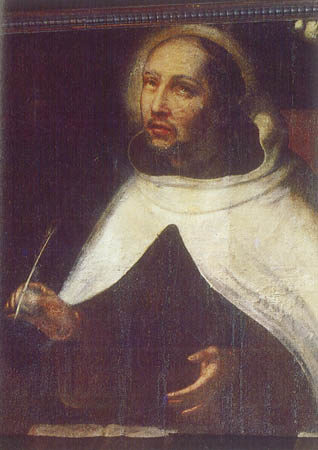
St. John of the Cross

Liturgy of the Hours
  • Priest and Doctor
  • Solemnity
  • Carmelite Proper
Born:    
  • Juan de Yepes Alvarez
  • 24 June 1542
  • Fontiveros, Spain
Died:  
  • December 14, 1591
  • Aged 49
  • Ubeda, Andalusia, Spain
Beatification
  • 25 January 1675
  • Pope Clement X
Canonization
  • 27 December 1726
  • Pope Benedict XIII
Feast Day:    14 December
                    24 November(General Roman Calendar, 1738-1969)

Major shrine  
  • Tomb of Saint John of the Cross
  • Segovia, Spain

John of the Cross (San Juan de la Cruz) (24 June 1542 – 14 December 1591), born Juan de Yepes Alvarez, was a major figure of the Counter-Reformation, a Spanish mystic, Catholic saint, Carmelite friar and priest, born at Fontiveros, Old Castile.

Saint John of the Cross was a reformer of the Carmelite Order and is considered, along with Saint Teresa of Ávila, as a founder of the Discalced Carmelites. He is also known for his writings. Both his poetry and his studies on the growth of the soul are considered the summit of mystical Spanish literature and one of the peaks of all Spanish literature. He was canonized as a saint in 1726 by Pope Benedict XIII. He is one of the thirty-three Doctors of the Church. When his feast day was inserted into the General Roman Calendar in 1738, it was assigned at first to 24 November, since his date of death was impeded by the then existing octave of the Feast of the Immaculate Conception. This obstacle was removed in 1955 and in 1969 his feast day was moved to his date of death, 14 December.

Early life and education

St. John was born by the name of Juan de Yepes Alvarez into a Jewish converso family in a small community near Ávila. His father died when he was young, and so John, his two older brothers and his widowed mother struggled with poverty, moving around and living in various Castilian villages, with the last being Medina del Campo, to which he moved in 1551. There he worked at a hospital and studied the humanities at a Society of Jesus (Jesuit) school from 1559 to 1563. The Society of Jesus was a new organization at the time, having been founded a few years earlier by the Spanish St. Ignatius Loyola. On 24 February 1563 he entered the Carmelite order, adopting the name Fr. Juan de Santo Matía.

The following year (1564) he professed as a Carmelite (was promoted from novice status) and moved to Salamanca, where he studied theology and philosophy at the University and at the Colegio de San Andrés. This stay would influence all his later writings, as Fray Luis de León taught biblical studies (Exegesis, Hebrew and Aramaic) at the University. León was one of the foremost experts in Biblical Studies then and had written an important and controversial translation of the Song of Songs into Spanish. (Translation of the Bible into the vernacular was not allowed then in Spain.)

Priesthood and association with Saint Teresa of Avila


Saint John was ordained a priest in 1567, and then indicated his intent to join the strict Carthusian order, which appealed to him because of its encouragement of solitary and silent contemplation. Before this, however, he traveled to Medina del Campo, where he met the charismatic Saint Teresa de Jesús. She immediately talked to him about her reformation projects for the Carmelite order, and asked him to delay his entry into the Carthusians. The following year, on 28 November, he started this reformation at Duruelo together with Fr. Antonio de Jesús de Heredia, and the originally small and impoverished town of Duruelo became a center of religion.

John, still in his 20s, continued to work as a helper of Saint Teresa until 1577, founding monasteries around Spain and taking active part in their government. These foundations and the reformation process were resisted by a great number of Carmelite friars, some of whom felt that Teresa's version of the order was too strict. Some of these opponents would even try to bar Teresa from entering their convents.

The followers of St. John and St. Teresa differentiated themselves from the non-reformed communities by calling themselves the "discalced", i.e., barefoot, and the others the "calced" Carmelites.

Imprisonment, writings, torture, death and recognition
On the night of 2 December 1577, John was taken prisoner by his superiors in the calced Carmelites, who had launched a counter-program against John and Teresa's reforms. John had refused an order to return to his original house, on the basis that his reform work had been approved by the Spanish Nuncio, a higher authority than John's direct superiors in the calced Carmelites.  John was jailed in Toledo, where he was kept under a brutal regimen that included public lashing before the community at least weekly, and severe isolation in a tiny stifling cell barely large enough for his body. He managed to escape nine months later, on 15 August 1578, through a small window in a room adjoining his cell. (He had managed to pry the cell door off its hinges earlier that day). In the meantime, he had composed a great part of his most famous poem Spiritual Canticle during this imprisonment; his harsh sufferings and spiritual endeavors are then reflected in all of his subsequent writings. The paper was passed to him by one of the friars guarding his cell.

After returning to a normal life, he went on with the reformation and the founding of monasteries for the new Discalced Carmelite order, which he had helped found along with his fellow St. Teresa de Ávila.

He died on 14 December 1591, of erysipelas. His writings were first published in 1618, and he was canonized by Benedict XIII in 1726. In 1926, he was declared a Doctor of the Church by Pope Pius XI. When inserted into the Roman Catholic calendar of saints in 1738, his feast day was assigned to 24 November.  Pope Paul VI moved it to the dies natalis (birthday to heaven) of the saint, 14 December.

The Church of England commemorates him as a "Teacher of the Faith" on the same date.

Literary works


St. John of the Cross is considered one of the foremost poets in the Spanish language. Although his complete poems add up to fewer than 2500 verses, two of them—the Spiritual Canticle and Dark Night of the Soul are widely considered to be among the best poems ever written in Spanish, both for their formal stylistic point of view and their rich symbolism and imagery.

The Spiritual Canticle is an eclogue in which the bride (representing the soul) searches for the bridegroom (representing Jesus Christ), and is anxious at having lost him; both are filled with joy upon reuniting. It can be seen as a free-form Spanish version of the Song of Songs at a time when translations of the Bible into the vernacular were forbidden.

Dark Night of the Soul (from which the spiritual term takes its name) narrates the journey of the soul from her bodily home to her union with God. It happens during the night, which represents the hardships and difficulties she meets in detachment from the world and reaching the light of the union with the Creator. There are several steps in this night, which are related in successive stanzas. The main idea of the poem can be seen as the painful experience that people endure as they seek to grow in spiritual maturity and union with God. A year after writing this poem, in 1586 he wrote a commentary on Dark Night of the Soul with the same title. This commentary explains the meaning of the poem verse by verse.

St. John also wrote four treatises on mystical theology, two treatises concerning the two poems above, which set out to explain the true meaning of the poems verse by verse and even word by word.

The third work, Ascent of Mount Carmel is a more systematic study of the ascetical endeavour of a soul looking for perfect union, God, and the mystical events happening along the way. A four stanza work, Living Flame of Love describes a greater intimacy, as the soul responds to God's love. These, together with his Dichos de Luz y Amor, or "Sayings of Light and Love," and St. Teresa's writings, are the most important mystical works in Spanish, and have deeply influenced later spiritual writers all around the world. Among these can be named T. S. Eliot, Thérèse de Lisieux, Edith Stein (Teresa Benedicta of the Cross), and Thomas Merton. John has also influenced philosophers (Jacques Maritain), theologians (Hans Urs von Balthasar), pacifists (Dorothy Day, Daniel Berrigan, and Philip Berrigan) and artists (Salvador Dalí). Pope John Paul II wrote his theological dissertation on the mystical theology of Saint John of the Cross. Saint John is also mentioned in Allen Ginsberg's groundbreaking poem Howl,[and is quoted by Jonas Mekas in his epic film-diary work 'Walden'.


Notes:

*Added the Discaced Carmelites Liturgy of the Hours
** Citations were removed but can be found on the Original site

Resources:

OCDS Calendar for the Liturgy of the Hours, 2009  

John of the Cross. (2011, July 30). In Wikipedia, The Free Encyclopedia. Retrieved 16:31, August 2, 2011, from http://en.wikipedia.org/w/index.php?title=John_of_the_Cross&oldid=442135578 


Text: under http://creativecommons.org/licenses/by-sa/3.0/
 

Wednesday, November 18, 2009

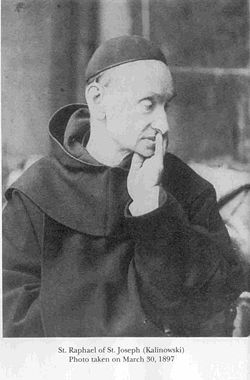
Saint Raphael Kalinowski of St. Joseph


Liturgy of the Hours

  • Priest
  • Memorial
  • Carmelite Proper

Born:

  • September 1, 1835
  • Place:  Vilnius, Lithuania

Died:   

  • November 15, 1907
  • 72
  • Wadowice, Poland

Beatification:

  • 1983
  • Krakow, Poland
  • Pope John Paul II

Canonization:

  • November 17, 1991
  • St. Peter's Basilica
  • Pope John Paul II

Feast Day: November 19

Resources:

Recent Posts

Disclaimer

Articles written in this blog, unless otherwise sourced, is the sole opinion of the writer and does not carry nor imply the opinion of the Entire order of Carmel, the Vatican nor the Universal Church. With this, all my personal writings, I hereby subject to correction by the teaching Authority of the Catholic Church, the keeper and Authority on Divine Revelations.

The Bread of Life Catholic Webring